
AI Legal: How Artificial Intelligence Is Changing Legal Help in 2026
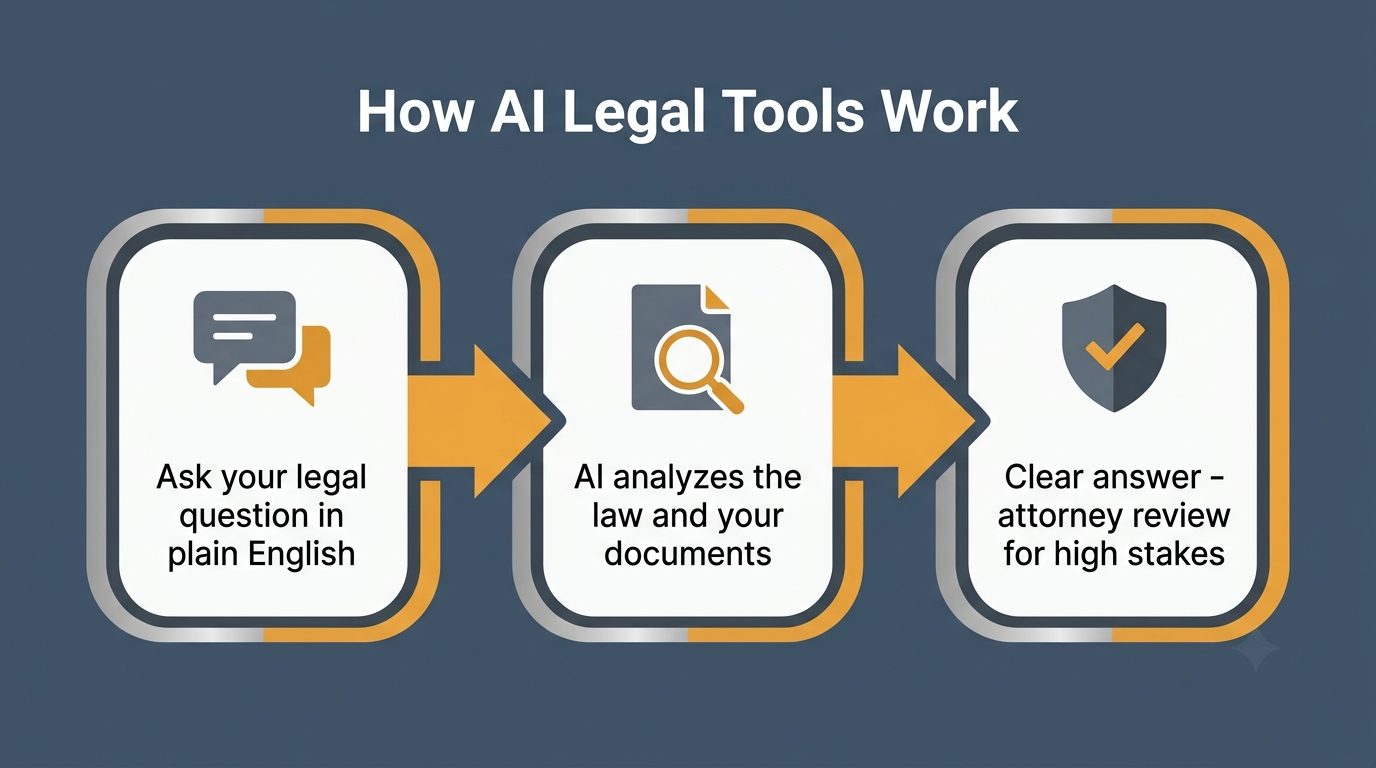
AI legal refers to generative and agentic artificial intelligence applied to legal tasks — answering everyday legal questions, reviewing documents, drafting contracts, and researching case law. An AI legal assistant can respond to legal questions around the clock, summarize contracts in seconds, and save the average lawyer roughly 240 hours a year, according to Thomson Reuters. What it cannot do is replace a licensed attorney for decisions specific to your case.
This article is for informational purposes only and is not legal advice. Always consult a licensed attorney for guidance on your specific situation.
What Does “AI Legal” Actually Mean?
“AI legal” covers two overlapping ideas: general-purpose AI chatbots being used for legal questions, and purpose-built legal AI software designed specifically for legal work. Both rely on generative AI — models trained to produce human-like text, summaries, and drafts from a prompt. The term also increasingly includes agentic AI, which goes a step further by carrying out multi-step legal tasks rather than just answering a single question. As defined in the broader field of artificial intelligence and law, these systems are applied across legal research, prediction of case outcomes, and document automation.
From ChatGPT to purpose-built legal AI
ChatGPT’s late-2022 launch triggered the current wave of generative AI adoption, including inside law firms. General-purpose chatbots like ChatGPT, Claude, Gemini, and Copilot are flexible but weren’t built for legal grounding — they aren’t trained specifically on case law, statutes, or firm-specific documents. Purpose-built legal AI, by contrast, is trained on legal data, grounded in verifiable primary sources, and built around data-protection requirements law firms need. Bloomberg Law notes that the strongest legal AI tools rely on supervised machine learning, one of three broad categories of machine learning — supervised, unsupervised, and reinforcement learning — each suited to different legal tasks.
Generative vs. agentic legal AI
Generative AI produces text from a prompt: a summary, a draft clause, an answer to a question. Agentic AI works differently — it breaks a legal task into steps, pulls in outside sources and tools, and carries the task through to completion with less human prompting at each stage. Agentic AI is the dominant trend heading into 2026, with platforms like Harvey Agents and Legora’s aOS built around this model. The core risk with any generative system is hallucination — the AI can invent a case citation or legal authority that doesn’t exist, which is why human review of AI output remains mandatory before anything is filed or relied upon.
How AI Is Used in the Legal Field
AI has moved from experimental to routine across several legal workflows: legal research, document review, contract drafting, e-discovery, and drafting demand letters. According to Thomson Reuters’ 2025 data, document review is the single most common use case, with legal research and contract work close behind.
| Use case | Share of legal professionals using AI for it |
|---|---|
| Document review | 77% |
| Legal research | 74% |
| Document summarization | 74% |
| Briefs and memos | 59% |
| Contract drafting | 58% |
Top use cases with adoption numbers
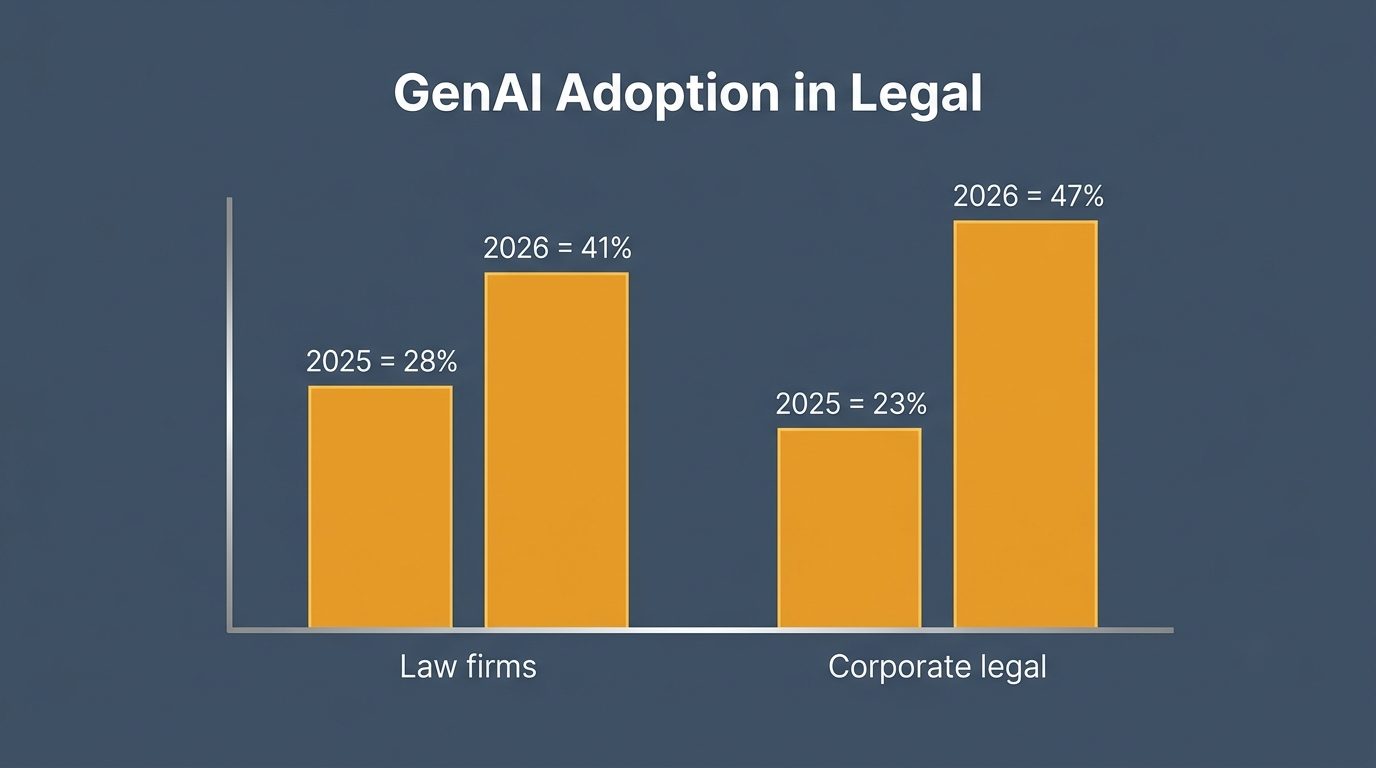
Thomson Reuters’ 2026 Future of Professionals Report puts GenAI adoption at 41% of law firms and 47% of corporate legal departments — up sharply from 28% and 23% respectively in 2025. Adoption among individual lawyers jumped even faster industry-wide, from about 19% in 2023 to 79% in 2024. Eighty percent of surveyed lawyers expect AI to have a transformational effect on their practice within five years.
Generative AI is no longer an experiment for the legal profession — it has become embedded in daily workflows across research, drafting, and review.
Thomson Reuters Future of Professionals Report
What the time savings look like
Thomson Reuters estimates AI saves the average lawyer around 240 hours per year. Vendor-reported figures point in the same direction: Harvey claims its platform saves specialists 20-plus hours a month and counts more than 142,000 legal professionals as users, including staff at 60 of the AmLaw 100 firms. The broader legal tech market was valued at roughly $29.81 billion in 2025 and is projected to reach $65.51 billion by 2034. About 53% of firms already report a measurable return on their AI investment.

AI Legal Help for Everyday Questions (Not Just Lawyers)
AI legal tools aren’t only built for law firms — a growing share serve consumers directly. An AI legal chat assistant can walk someone through a rental dispute, explain a confusing clause in a lease, or draft a demand letter, all without an appointment, and it’s available 24/7.
What an AI legal assistant can do for consumers
Common consumer use cases include questions on family law, employment disputes, consumer rights, rental and landlord disputes, debt collection, and traffic fines. These tools also explain dense legal documents in plain language and draft first versions of letters — demand letters, complaint letters, cease-and-desist notices. Many offer free tiers alongside paid plans. Vendors in this space, such as AI Lawyer, advertise up to 75% time savings and 90% lower cost compared to traditional legal services, with document summaries generated in as little as five seconds — figures that should be read as vendor claims rather than independently verified benchmarks.
- Describe your situation in plain language to the AI legal assistant.
- Ask it to identify the relevant area of law (e.g., landlord-tenant, employment).
- Request a plain-language explanation of any document involved.
- Ask for a draft letter or next-step checklist if applicable.
- Review the draft carefully — AI can miss local rules or make factual errors.
- For anything with real stakes, take the draft to a licensed attorney before acting.
- Use a legal aid directory if you can’t afford a private attorney.
When you still need a human attorney
AI legal tools have clear limits: they cannot appear in court, negotiate on your behalf, or represent you, and they shouldn’t be trusted alone for high-stakes matters like criminal charges, immigration cases, or child custody. An AI assistant provides legal information, not legal advice — for a decision specific to your case, consult a licensed attorney in your state. If cost is the barrier, government-backed resources like usa.gov’s legal aid directory or the Legal Services Corporation can connect you with free or low-cost legal help.

AI Tools for Lawyers and Law Firms
Professional legal AI platforms have matured into a crowded market, each with a different focus — research, contract analysis, e-discovery, or client intake.
The 2026 legal AI landscape
Legal AI tools generally fall into eight categories: legal research, contract analysis, predictive analytics, e-discovery, chatbots, document automation, litigation management, and client intake. Tools tend to cluster by firm size and practice area — large-firm research and drafting platforms serve one segment, while solo and small-firm tools, or plaintiff-firm intake platforms, serve others.
| Category | Typical focus | Best suited for |
|---|---|---|
| Research platforms | Case law search, grounded citations | Large firms, litigation teams |
| Contract analysis | Drafting, review, redlining | Transactional practices |
| Client intake / chat | 24/7 lead capture, triage | Plaintiff and consumer-facing firms |
| Document automation | Templates, demand letters | Solo and small firms |
| e-Discovery | Document review at scale | Litigation support teams |
How firms measure results
Vendors report substantial operational gains from adopting legal AI. One plaintiff-focused platform reports settlement values up 15-30% and demand letters produced 90% faster across more than 1,200 client firms, alongside a 90% reduction in discovery response time. A separate ROI report from a research-focused legal AI vendor found that 30% of firms using its platform reduced non-billable hours, with some large firms reporting roughly $2.0 million in additional billable capacity per 100 lawyers. These are vendor-reported figures, not independently audited results, and should be treated as claims to verify rather than guaranteed outcomes.
Can AI Give Legal Advice? Ethics and Limits
The short answer, according to the profession itself, is no — not in the sense of advice a client should rely on without attorney review.
What the profession says
Thomson Reuters’ 2026 survey found that 83% of legal professionals consider it inappropriate for AI to give legal advice directly to clients, and 96% oppose AI representing a client in court. Separately, 96% of respondents said safeguards for confidential data are essential, 94% want AI grounded in authoritative legal content, and 90% want explainable reasoning behind AI outputs — not black-box answers.
Bar associations and supervision rules
By 2025, 16 state bar associations had issued or were developing formal guidance on AI use in legal practice, and all nine published ethics opinions to date focus on a lawyer’s duty to supervise AI output. The Florida Bar’s 2024 guidance is direct on this point: treat generative AI’s work product the way you would a paralegal’s — review it before relying on it. This tracks the American Bar Association’s Model Rules, which hold a lawyer responsible for the work of nonlawyer assistants, a category that now extends to AI tools. See the American Bar Association’s guidance on AI and professional responsibility for the underlying rules. This is exactly why AI legal tools are not a substitute for advice from a licensed attorney — for any decision affecting your legal rights, consult one directly.
Is Your Data Safe with Legal AI?
Data handling is one of the biggest practical concerns firms and consumers raise about legal AI, and it’s a legitimate one — 37% of legal professionals cite data security as a barrier to adoption.
Privilege and confidentiality risks
Courts have found that entering details of an active case into a consumer-grade AI chatbot can jeopardize attorney-client privilege, since privilege generally depends on communications staying within a confidential relationship. The practical rule: don’t input sensitive case details into general-purpose tools that lack confidentiality guarantees. Specialized legal AI platforms typically isolate each client’s data per firm rather than pooling it.
Security standards to look for
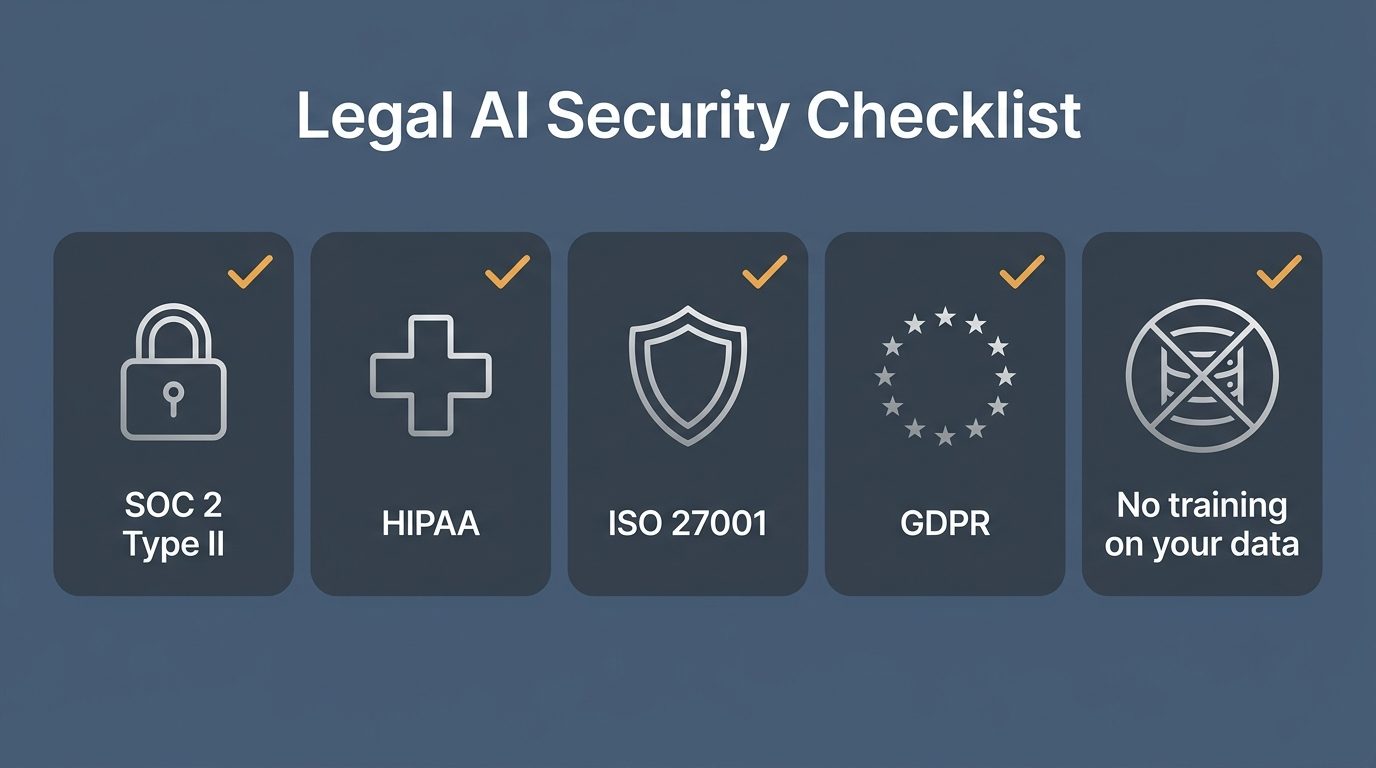
Before trusting any platform with legal documents, check for a defined set of security credentials.
- SOC 2 Type II certification, covering data handling controls
- HIPAA compliance, if any medical records are involved
- ISO 27001 or ISO 42001 certification, covering information security and AI governance
- GDPR compliance for any EU-connected data
- An explicit “no training on your data” policy
These standards are now baseline expectations among serious legal AI vendors, not differentiators.

Will AI Replace Lawyers?
The consensus across the legal profession is no — AI automates specific tasks, it doesn’t replace legal judgment.
Augmentation, not replacement
AI is automating the routine layers of legal work — document review, first-pass research, initial drafting — while judgment, strategy, and courtroom advocacy remain with human lawyers. New roles are emerging as a direct result: 39% of firms report creating AI-specialist positions, and 33% have created AI implementation manager roles. Sentiment has shifted too — lawyers describing themselves as “hopeful” or “excited” about AI rose by 11 percentage points year over year. A well-built virtual legal assistant fits into this shift as a support tool for routine questions, not a replacement for the lawyer making the final call.
What it means for clients
For clients, the practical upside is lower cost for routine legal services, faster turnaround on document review and correspondence, and better access to justice — some legal aid organizations now use AI to stretch limited resources further for low-income clients. Final decisions, though, stay with people: 48% of lawyers surveyed say they’re concerned about AI’s effect on independent professional judgment over time, which is one more reason to treat AI output as a draft, not a verdict.
Frequently Asked Questions
- Can AI give legal advice?
No. An AI legal assistant can provide general legal information, not legal advice — 83% of legal professionals say AI-generated advice is inappropriate for client use. For guidance on your specific situation, consult a licensed attorney. This is not legal advice.
- How is AI used in the legal field?
The top uses are document review (77%), legal research (74%), and drafting briefs, memos, and contracts (58-59%), based on Thomson Reuters’ 2025 data. AI is also used for client intake, e-discovery, and drafting demand letters.
- Will AI replace lawyers?
No. AI automates routine tasks like research and document review, but courts, bar associations, and clients still require human judgment and supervision. New roles, such as AI-specialist positions, are emerging alongside the technology rather than replacing legal staff.
- Is an AI legal assistant free?
Many consumer-facing AI legal chat tools offer free access around the clock, and professional platforms often include a free trial. Full-featured professional legal AI software is typically subscription-based.
- Is it safe to share my legal documents with AI?
Only with platforms that carry SOC 2, HIPAA, or ISO 27001/42001 certification and a clear no-training-on-your-data policy. Entering sensitive case details into a general-purpose consumer chatbot can put attorney-client privilege at risk.
- What’s the difference between ChatGPT and a legal AI assistant?
ChatGPT is a general-purpose chatbot not trained specifically on legal sources. A purpose-built legal AI assistant is grounded in legal data, designed to reduce hallucinated citations, built with legal-grade confidentiality controls, and structured around legal workflows like research and contract review.